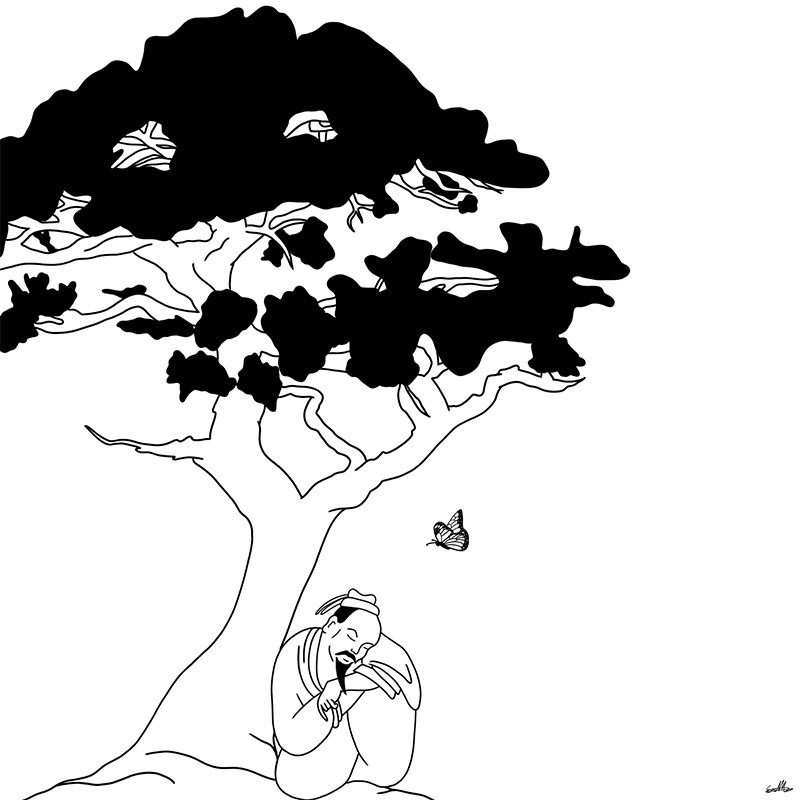
Zhuang Zi and the butterfly
In his book “The Order of Time”, Carlo Rovelli describes that a universal time does not exist and also explains why this is so according to Einstein’s special theory of relativity. He shows that each of us creates his or her own time. Time runs faster for someone 3500 metres up in the mountains than for someone in the polder, below sea level. Each height between these 3500 metres and sea level has its own specific time.
This is a physical fact. Time arises as an emergent property, when heat moves to a cooler place. Time is therefore not an always and everywhere present quantity in our universe. Our universe is a continuous and incessant process of change. In the Taoist worldview, we call this Tao. And this Tao or this continuous process of change is determined by independent parts, which in Taoist philosophy are called De.
Tao is determined by De, but the De are not the parts of the whole, the Tao. The are universes in themselves. And Tao is always interpreted from a specific process. Taoism therefore does not presuppose a universe or a time. Within this worldview, there is no difference between what is or how it is. There is no distinction between form and content. There is no being that underlies becoming. Or as the Taoist thinker Yuan Minqi puts it:
The body is not a mind,
the mind is not a body.
The body is mind,
mind is body.
There is no body,
there is no mind.
There is no creation,
there is no creator.
The creation is the creator,
the creator is the creation.
The, the independent parts, are universes in themselves, both in what they are and in how they are. They are their own creative source. The Tao is like a field in which The are different perspectives. Each perspective in itself describes a complete universe.
In Western philosophy, we recognise here Nietzsche’s idea of the “will-to-power”, in which he assumes that there are infinitely many perspectives moving in a dynamic continuum. Each perspective in itself determines the conditions to which it relates in relation to other perspectives. It is therefore completely free. And the question of free will, as in Taoism, is irrelevant. Each perspective is as free as it allows itself to be. But for another perspective, it is completely determined. That is why the Tao De Jing begins in chapter 1 with the line: “The Tao one talks about is not the true Tao”.
Nietzsche writes in his book “Also sprach Zarathoestra”: “‘This now is my way, where is yours?’ was my answer to those who asked ‘for the way’. For the way, there is no way!”
“One day I, Zhuang Zi, dreamt that I was a butterfly, a butterfly fluttering about, content with itself, and unaware that it was me. Suddenly I woke up and began to realise that I was still Zhuang Zi. Now the question is whether I am Zhuang Zi who dreamed that he was a butterfly, or a butterfly who dreamed that he was me’.
Both realities, of the butterfly and of Zhuang Zi, are realities. Not only in the philosophy of Nietzsche and Taoism, but also in the physics of Albert Einstein, Carlo Rovelli, Stephen Hawking, Roger Penrose and classic text Huai Nan Zi.
If you want to delve further, I can highly recommend the publications of Daan Oostveen. He has written beautifully on the comparison between Nietzsche and Taoism. And of course the great translation of Zhuang Zi by Kristofer Schipper. The book by Carlo Rovelli “The Order of Time” and “The Nature of Space and Time” by Stephen Hawking and Roger Penrose.
