
Oxrider
7 October 2020
In the ShiJi (literally “Historical Survey”) from 85 B.C. the Chinese historian and scientist Sima Qian describes the life of Lao Zi, the first philosopher of Chinese Taoism and the probable author of the Dao De Jing. There is a lot of discussion as to whether Lao Zi really existed or whether he is a fictional person who is used to shape the ideas of Taoism. The fact is that ShiJi is the primary source where the story of the founder of Taoism is told.
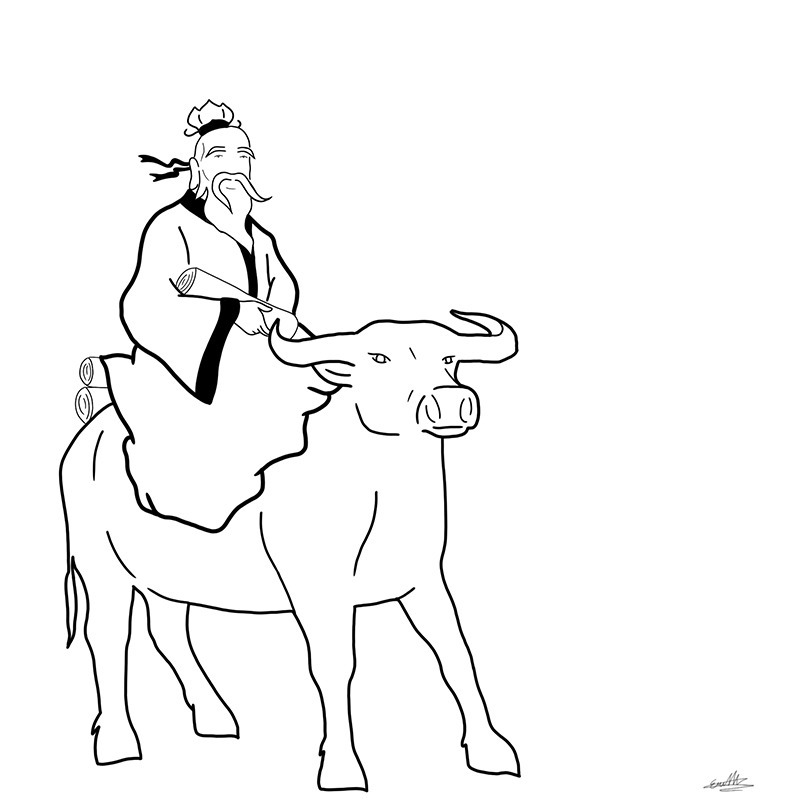
Lao Zi is not his original name, but more of an honorary title. Literally translated, Lao Zi means “Old Master” or “Venerable Old Sir”. His real name was Li Er and he was born in the town of Quren, in the district of Hu in the state of Chu. Nowadays this is the town of Luyi in the province of Henan.
He had a job as a historian and administrator of the holy books at the royal court of the Zhou dynasty (1046-256 BC).
When he saw that the moral and cultural decline of the Zhou dynasty was taking on ever greater proportions, Li Er decided to leave the court and the kingdom. He left everything behind and because he feared for his life, he discreetly tried to leave the kingdom via the western mountains. Riding on the back of an ox he arrived at the Xiangu pass, where he was stopped by the legendary guard of this pass, Guanling. He begged him not to simply disappear and to deprive the people of the kingdom of Zhou of his wisdom. He asked Lao Zi to record his knowledge in a book. Lao Zi then wrote the 5000 character classical book, the “Dao De Jing”. Literally translated as “the classical work about the going of the Way and Virtue”. And when he handed this book to Guanling, Lao Zi disappeared, sitting on the back of his ox.
The work we do at Oxrider Clinic and Oxrider Academy is rooted in the philosophy of Taoism. The modern system biological approach to life, health and well-being also fits in seamlessly with this and uses and confirms these centuries-old insights and observations.
That is why our company, in all modesty, is named after the founder of this philosophy, the ox rider Lao Zi.
